
























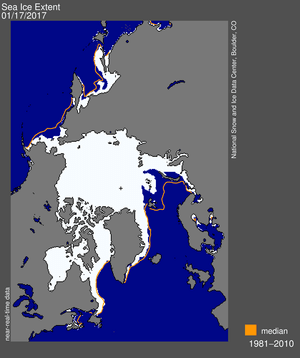
Very cool summer allowed the ice of the North Pole to melt less than in years past, and especially compared to the disastrous 2012. Meanwhile, in the Antarctic, sea ice reached the highest extent recorded in the satellite record.

Meanwhile, in the Antarctic, sea ice reached the highest extent recorded in the satellite record.
In 2013 year the Ice loss slowed down in August to only a little faster than average rates of loss for that time of year. In comparison, during 2012, the rate of loss accelerated in early June and through July, then accelerated even more in August to produce a new record low extent in September 2012.

The graph above shows Arctic sea ice extent as of September 30, 2013, along with daily ice extent data for the previous five years. 2013 is shown in light blue, 2012 in green, 2011 in orange, 2010 in light purple, 2009 in dark blue, and 2008 in dark purple.
This year was notably different than 2012. Because this year’s wind pattern was different than 2012, the multiyear ice largely remained in a compact area along the Canadian Archipelago and did not circulate into the Beaufort and Chukchi seas. The cooler conditions this summer also helped preserve more of the first-year ice through the summer.

These images from March 2013 (top) and September 2013 (bottom) show the changes in multiyear ice between this year’s sea ice maximum and minimum extents. In contrast to 2012, the record low extent year, multiyear ice tended to stay put, rather than being circulated around, which can expose it to warmer currents and winds that increase melt. Much of the Arctic ice cover now consists of first-year ice (shown in purple), which tends to melt rapidly in summer’s warmth.
Antarctic sea ice extent reached 19.47 million square kilometers (7.52 million square miles) on September 22, a record high maximum extent relative to the satellite record, and slightly above the previous record high set last year.

Antarctic sea ice extent for September 2013 was 19.77 million square kilometers (7.63 million square miles). The magenta line shows the 1981 to 2010 median extent for that month.

















 CLIMATE, GIS AND DATA SCIENCE